You are currently viewing How to Choose the Correct Statistical Test in Biomedicine

How to Choose the Correct Statistical Test in Biomedicine

Are you starting your Master’s Thesis or Doctoral Dissertation and find yourself stuck on the question: “Which is the correct statistical test?” You are not alone. This doubt paralyzes many researchers just when they most need to make progress. Choosing incorrectly will not only make you waste valuable time, but it can compromise the validity of your entire project.

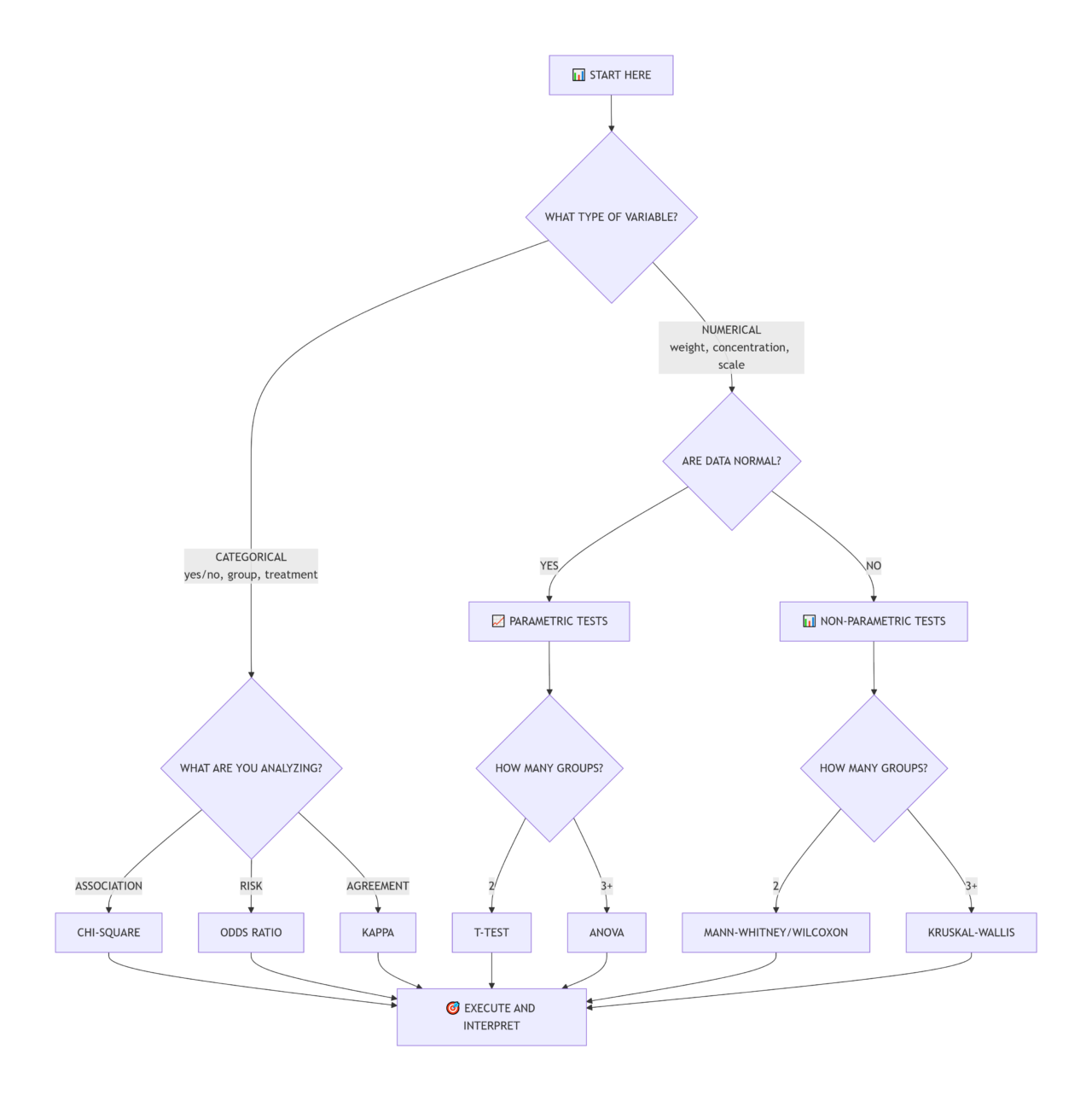
The good news is that selecting the correct statistical test does not require you to be a statistics expert, but rather to follow a clear methodology. In this practical guide, we provide you with a simple flowchart and concrete examples from biomedical research so you can make the right decision from day one.

To choose the correct statistical test: answer these 3 questions

What is your main hypothesis?

All statistical analysis begins with a clear question. Before looking at your data, state exactly what you want to prove or compare. For example: “Drug A reduces blood pressure more than drug B” or “There is a correlation between cholesterol levels and cardiovascular risk.”

What type of variables are you working with?

Identify your variables as qualitative (categorical) or quantitative (numerical). This distinction is crucial: you wouldn’t use the same tools to compare patient groups (qualitative) as you would to measure protein concentrations (quantitative).

How are your groups distributed?

Are you comparing two independent groups (like patients vs. controls)? Or are they repeated measurements on the same individuals (before/after treatment)? This design determines whether you need tests for independent or paired samples.

Choose the correct statistical test

choose the correct statistical test

Example 1 – Preclinical study: You want to compare tumor weight between mice treated with a new drug vs. a control.

1️⃣ Variable: Tumor weight → it’s a number → left branch.

2️⃣ Normality: You verify with Shapiro-Wilk → data is normally distributed.

3️⃣ Groups: These are 2 independent groups (treatment vs. control).

4️⃣ Chosen test: t-test for independent samples.

Example 2 – Clinical survey: You want to know if there is a relationship between gender (male/female) and the presence of a mutation (yes/no).

1️⃣ Variables: Both are categories → right branch.

2️⃣ Type of analysis: You are looking for an association between two qualitative variables.

3️⃣ Chosen test: Chi-square.

Most Common Mistakes When Choosing Statistical Tests

Mistake 1: Not planning the analysis before collecting data

One of the most costly errors is deciding on the statistical analysis after you have the data. This leads to problems like insufficient sample size, lack of adequate controls, or a design unsuitable for the tests you need. Statistics must be planned during the experimental design phase, not as an afterthought.

Mistake 2: Choosing the test based only on the type of variable

It is not enough to identify whether your variable is numerical or categorical. The research question comes first. The same dataset can be analyzed in different ways depending on what you want to prove. For example, an “age” variable can be treated as numerical (correlation with another variable) or categorical (comparing age groups).

Mistake 3: Assuming normality without verifying it

Parametric tests (t-test, ANOVA) are often run directly without checking if the data meets the required assumptions. In biomedicine, data often have non-normal distributions: pain scales, cell counts, reaction times. Always verify normality with tests like Shapiro-Wilk or Kolmogorov-Smirnov, and supplement with Q-Q plots.

Mistake 4: Ignoring the experimental design

Are your samples independent or paired? This detail completely changes the test. A before/after study with the same patients requires a paired test, while comparing two different groups requires an independent test. Confusing them invalidates the results.

Do you need personalized help with your experimental design?

Do your data not meet the assumptions? Do you have a complex design that doesn’t fit these examples?

Don’t let statistical doubts delay your research. At BioDatev, we offer personalized statistical design consultations for research groups. Together, we will review your hypothesis, variables, and experimental design to build the most robust analytical strategy for your project.

Don't Wait to Unlock Your Data's Potential

Contact Our Experts and Start Seeing Results!